As an Amazon Associate, we earn from qualifying purchases. Some links on this site are affiliate links at no extra cost to you. Our recommendations are based on thorough research and editorial judgment.


10 Best Nearfield Studio Monitors for 2026: Your Ultimate Guide to Precision Sound

Looking for the best nearfield studio monitors in 2026? You’ll want to check out the Edifier MR4 for its balanced sound, or the KRK GoAux 3 if you need something portable. The Yamaha HS4 and Ortizan C7 offer great connectivity and design, while the ADAM Audio T5V impresses with wide frequency response. If you’re tight on space, the PreSonus Eris 3.5 is a solid pick. Want more inside info on picking the right ones? Let’s keep going!
Key Takeaways
- Look for studio monitors with near-flat response curves to ensure accurate audio reproduction for professional sound quality.
- Consider connectivity options like USB-C, TRS, and RCA inputs to enhance compatibility with various devices in your studio setup.
- Monitor size and design matter; compact models, such as the PreSonus Eris E3.5, are ideal for small spaces while maintaining sound quality.
- High signal-to-noise ratios (above 95 dB) contribute to clearer sound, essential for mixing and production environments.
- Evaluate features like built-in EQ controls to customize sound for your specific room acoustics and listening preferences.
Edifier MR4 Powered Studio Monitor Speakers (Black)
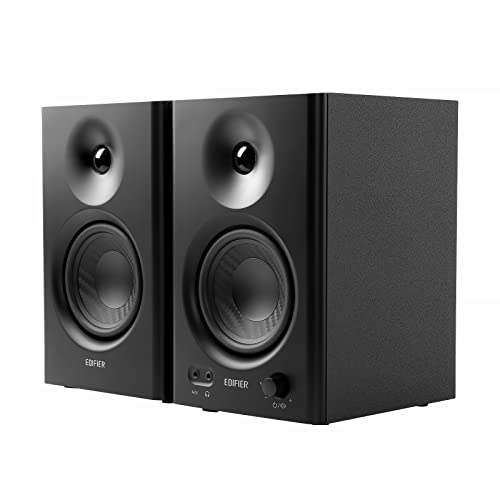
Edifier MR4 Powered Studio Monitor Speakers, 4" Active Near-Field Reference Speaker - Black (Pair)
- TRUE STUDIO MONITOR - Based on the highly rated Edifier bookshelf speakers professionally tuned to a responsive almost flat curve for artists and music creators.
- STUDIO QUALITY SOUND - The 1" silk dome tweeter and 4" composite woofer produce clear, smooth, and overall sound. MDF wood texture helps reduce resonance and reveal true...
- FLEXIBLE CONNECTORS - 1/4" balanced TRS input, an unbalanced RCA input, an unbalanced AUX input and a front headphone output are equipped for connecting devices such as...
If you’re diving into music production or just want to enjoy high-quality sound at home, the Edifier MR4 Powered Studio Monitor Speakers (Black) are a fantastic choice. These 4-inch active near-field monitors offer studio-quality audio that’ll have you listening like a pro. With a silk dome tweeter and composite woofer, they deliver clear sound while the MDF wood texture minimizes resonance. Connect with ease using flexible inputs—perfect for your mixers, computers, or tablets. Despite their serious capabilities, they’ve got a dual mode for both professional and casual listening. Yes, they look sleek, but trust me, they sound even better!
Best For: Those looking for high-quality studio monitor speakers for music production or casual listening at home.
Pros:
- Studio-quality sound with responsive audio and minimized resonance thanks to MDF wood texture.
- Versatile connectivity options for mixers, computers, and tablets.
- Dual mode design allows easy switching between professional monitoring and casual listening.
Cons:
- May be too powerful for small spaces, leading to potential over-saturation of sound.
- Limited low-frequency response due to the 4-inch woofer size, may require a subwoofer for bass-heavy music.
- Some users may find the high and low frequency controls unintuitive without proper experience.
Edifier MR4 Powered Studio Monitor Speakers (Pair)

Edifier MR4 42W Powered Monitor Speakers, 1" Tweeter & 4" Woofer, Balanced TRS/RCA/AUX...
- TRUE STUDIO MONITOR – Based on the highly reviewed Edifier bookshelf speakers, professionally fine-tuned to a near-flat responsive curve for artists and music creators.
- STUDIO QUALITY SOUND – 1-inch silk dome tweeters and 4-inch composite woofers produce a clear, smooth, and overall sound. MDF wooden structure helps to reduce resonance...
- FLEXIBLE CONNECTIONS – 1/4-inch balanced TRS input, an unbalanced RCA input, an unbalanced AUX input, and a front headphone output are equipped to connect to devices...
The Edifier MR4 Powered Studio Monitor Speakers are an excellent choice for aspiring producers and seasoned musicians alike. With their 4-inch active near-field monitors, they deliver studio-quality sound that’ll impress you. You’ll enjoy a near-flat response curve, thanks to the 1-inch silk dome tweeters and composite woofers. The MDF wooden structure minimizes resonance, giving you true audio clarity.
Flexible connections? You bet! These speakers include TRS, RCA, and AUX inputs, plus a handy headphone output. You can easily switch between monitor and music modes, and those user-friendly controls? A breeze! High and low frequency adjustments keep your sound just right.
Best For: Aspiring producers, seasoned musicians, and anyone looking for studio-quality sound in a compact setup.
Pros:
- Professionally fine-tuned for accurate audio reproduction with a near-flat response curve.
- Multiple connection options for flexibility, including TRS, RCA, AUX, and headphone output.
- Dual mode design allows seamless switching between monitor mode for production and music mode for casual listening.
Cons:
- Limited low-end response may not satisfy those seeking bass-heavy sound.
- The wooden structure may require careful placement to avoid resonance issues in certain environments.
- Lack of Bluetooth connectivity may limit usability with wireless devices.
KRK GoAux 3 3″ Portable Monitors, 3 inches (GOAUX3-NA)

KRK GoAux 3 3" Portable Monitors
- Perfect for traveling musicians and engineers, they deliver renowned KRK sound quality in a mobile-friendly size
- Travel-ready soft case for on-the-go recording sessions
- Packed with everything you need for professional quality setup
Looking for a compact yet powerful audio solution? The KRK GoAux 3 portable monitors are your new best friends. With a 3-inch glass aramid woofer and a 1-inch textile dome tweeter, these babies deliver impressive sound, boasting 60W RMS of total power. Weighing just 10.18 pounds, they’re built for travel, complete with a soft case and adjustable stands. Need connectivity? They’ve got you covered with wired inputs, Bluetooth, and a headphone output. Plus, their rear-ported ABS design guarantees durability. Honestly, who doesn’t love great sound on the go? With a 4.5-star rating, these are a top pick for sound enthusiasts!
Best For: Audio professionals, musicians, and sound enthusiasts looking for a portable and powerful monitoring solution.
Pros:
- Compact design and lightweight build make it easy to transport.
- Excellent sound quality with a 3” woofer and 1” tweeter, delivering 60W RMS power.
- Versatile connectivity options including Bluetooth, wired inputs, and headphone output for flexible usage.
Cons:
- The 3-inch size may not provide the same low-frequency response as larger monitors.
- Limited power for larger spaces as they are designed for portability and personal use.
- Rear-ported design may require careful placement to avoid bass reflections in some environments.
Yamaha HS4 Powered Studio Monitor in Black, Pair (HS4 B)

Yamaha HS4 Powered Studio Monitor in Black, Pair (HS4 B)
- Packaging: Pair
- 2-way bass-refiex powered speaker with 4.5" cone woofer and 1" dome tweeter
- 60 Hz - 22 kHz frequency response (-10 dB)
For anyone diving into music production or video editing, the Yamaha HS4 Powered Studio Monitor (HS4 B) shines as a remarkable choice. With its sleek black design, it’s not just a pretty face; it delivers powerful sound with a 4.5-inch woofer and a 1-inch tweeter. You’ll get crisp audio ranging from 60 Hz to 22 kHz, ideal for your mixing needs. Weighing in at just under 15 pounds, it’s perfectly sized for limited spaces. Plus, you can connect various devices easily. With a stellar 4.7-star rating, it’s clear these babies are a hit—perfect for every aspiring audio ninja out there!
Best For: Audio producers, video editors, and creators with limited space looking for high-quality sound monitoring.
Pros:
- Compact design: Weighs just under 15 pounds, making it ideal for small workspaces.
- Excellent sound quality: Features a wide frequency response of 60 Hz to 22 kHz for accurate audio reproduction.
- Versatile connectivity options: Compatible with various devices like laptops, smartphones, and gaming consoles.
Cons:
- Limited power output: With 26 W per speaker, may not be suitable for larger rooms or high-volume environments.
- No Bluetooth functionality: Lacks wireless connectivity, requiring wired connections for use.
- Price point: May be on the higher side for beginner setups compared to other studio monitors.
Ortizan C7 Dual-Mode Studio Monitors (Pair)
Sale

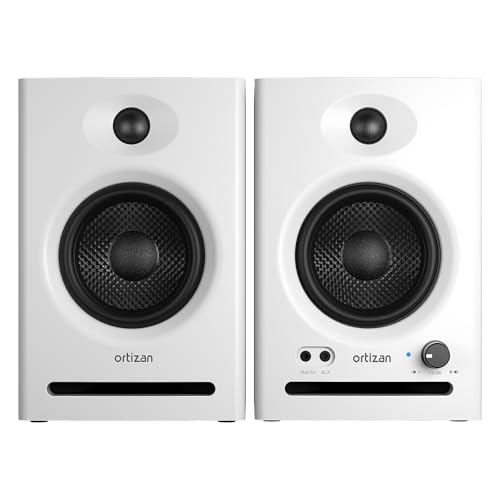
Ortizan C7 Dual-Mode 2.0 Studio Monitors, Active Monitor Speakers for Near Field Music Production...
- 【Multiple INPUTS】The stereo speakers home audio is built with RCA which ensure a lossless connection surround sound system for TV; With the addition of stable BT...
- 【HIFI BOOKSHELF SPEAKERS】The built-in 24-bit DAC captures digital audio directly via USB, minimizing signal loss during conversion and maximizing sound fidelity for...
- 【3.5 INCH CARBON FIBER SPEAKER AND 0.75inch SILK DOME TWEETER】The 0.75-inch tweeter and 3.5-inch mid-bass golden acoustic combination, with a suspended sound...

If you’re a budding producer or an audio enthusiast looking to elevate your sound game, Ortizan C7 Dual-Mode Studio Monitors might just be your ticket. These active 2.0 monitors blend exceptional audio performance with modern design. Sporting Bluetooth 5.3 for quick pairing, you’ll connect your devices in seconds—goodbye, tangled cables!
With a built-in 24-bit DAC and 3.5-inch carbon fiber speaker, the sound quality’s impressive, boasting an 85 dB signal-to-noise ratio. Plus, their compact size (5.11D x 5.9W x 7.67H inches) makes them perfect for any setup. At a 4.6-star rating, folks love ’em! Trust me, you’ll want to check these out!
Best For: Audio enthusiasts and budding producers seeking high-quality sound in a compact and stylish design.
Pros:
- Bluetooth 5.3 connectivity allows for quick and easy pairing with various devices, reducing cable clutter.
- Impressive audio fidelity with a built-in 24-bit DAC and a high-quality 3.5-inch carbon fiber speaker for accurate sound reproduction.
- Compact dimensions and modern design make them suitable for a variety of setups, including home studios and small spaces.
Cons:
- The speakers are not waterproof, which limits their outdoor usability.
- The weight (7.1 pounds per speaker) may be a concern for those looking for lightweight portable options.
- Some users may prefer additional features or customization options that are not present in basic studio monitors.
Mackie CR3.5 Creative Reference Powered Studio Monitors

Mackie CR3.5 3.5" Creative Reference Powered Studio Monitors with Tone Knob and Location Switch...
- Mackie CR3.5 Creative Reference Powered Studio Monitors combine studio-quality sound with a tone control, making CR3.5 the best studio monitors, gaming speakers and party...
- Connect CR3.5 to just about anything. Hook up audio interfaces and playback devices with TRS and RCA connectors. Play gaming consoles and PCs with the 3.5 mm input...
- Use the tone knob to shape the sound, starting with the transparent response you expect from studio monitors. Turn the knob to gradually boost the bass and add high-end...
Mackie CR3.5 Creative Reference Powered Studio Monitors are perfect for anyone needing high-quality sound without breaking the bank. These versatile speakers shine in music production, gaming, or just jamming out. You can easily connect them using TRS or RCA cables, plus a handy 3.5 mm input for your devices. With a tone control knob, you can boost that bass for gaming or keep it crisp when mixing tunes. Want to switch things up? The nifty location switch lets you choose between desktop and bookshelf modes. Just know, if you want deep bass, consider adding a CR8SBT subwoofer!
Best For: Individuals seeking an affordable yet high-quality sound solution for music production, gaming, or casual listening.
Pros:
- Versatile connectivity with TRS, RCA, and 3.5 mm inputs for various devices.
- Sound customization options with a tone control knob to enhance bass and treble.
- Flexible design featuring a location switch for optimal listening placement.
Cons:
- Limited deep bass performance without the addition of a subwoofer (CR8SBT sold separately).
- Size may not suit larger rooms, as the monitors are designed for close listening.
- Power output may not be sufficient for larger spaces or dedicated studio setups.
ADAM Audio D3V Active Desktop Monitoring System (Pair, Black)
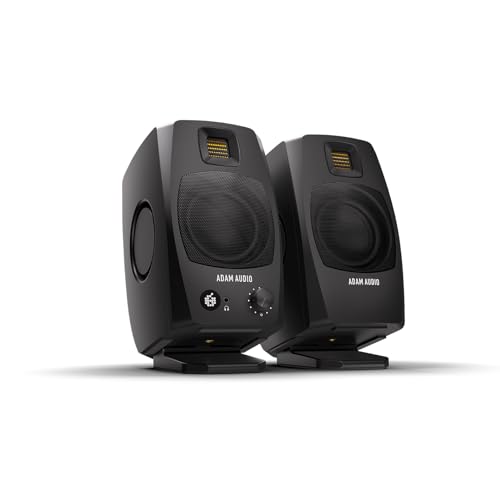
ADAM Audio D3V Active Desktop Monitoring System with USB-C Connection (Pair, Black)
- Bring ADAM Audio sound quality to your desk with the fully active D3V monitoring system. Designed for songwriters, producers, and music lovers, the stylish monitors can...
- Each pair features 3.5” aluminum woofers and ferrite magnet systems driven by 80 W amplifiers. The woofers are further complemented by dual-sided 3.5” passive...
- The D3V features a 1.5” D-ART (Desktop Accelerated Ribbon Tweeter) for the same precise and unfatiguing high-frequency reproduction that ADAM Audio’s established...
Searching for the perfect monitors can feel like a wild treasure hunt, but the ADAM Audio D3V Active Desktop Monitoring System is worth the quest. These sleek black monitors are tailor-made for songwriters and producers. You’ll love how they connect easily via USB-C to your computer or mobile devices.
The 3.5” aluminum woofers, paired with powerful 80 W amplifiers, guarantee impressive sound. Plus, dual 3.5” passive radiators enhance that low-end response to 45 Hz—great for deep beats. With detachable stands angled at 15°, you’ll enjoy an ideal listening position. Seriously, your ears will thank you for this upgrade!
Best For: The ADAM Audio D3V Active Desktop Monitoring System is best for songwriters, producers, and music lovers seeking professional-grade sound in a compact setup.
Pros:
- Excellent sound quality with 3.5” aluminum woofers and 80 W amplifiers that provide rich audio reproduction.
- USB-C connectivity for easy integration with computers and mobile devices.
- Angled detachable stands ensure an ergonomic listening position.
Cons:
- Limited low-end response may not satisfy bass-heavy music genres without additional subwoofers.
- Larger desktop footprint compared to smaller monitors.
- Price may be higher than entry-level alternatives for beginners.
ADAM Audio T5V Studio Monitor (Single)
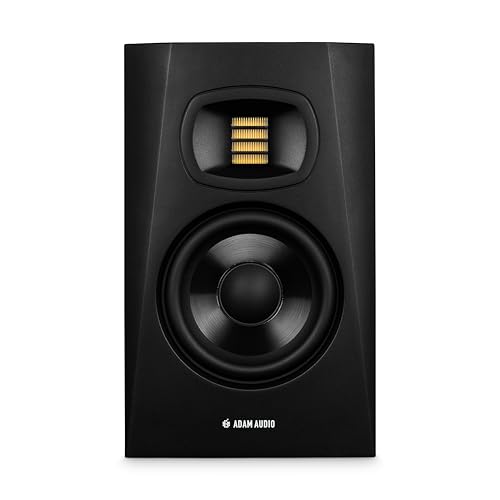
ADAM Audio T5V Studio Monitor for recording, mixing and mastering, Studio Quality Sound (Single)
- Transformative feedback for recording, producing, or mixing – Whether you are creating music, editing your next podcast, tracking guitar, or composing for film, the...
- High resolution audio designed in Berlin – The HPS waveguide and U-ART tweeter combine to deliver detailed sound across the high frequency spectrum
- Adjustable to fit your room – A beveled cabinet with a rear-firing bass reflex port allows placement anywhere, even with limited space. High- and low-shelf DSP-based...
For those diving into music production, podcasting, or film scoring, the ADAM Audio T5V Studio Monitor stands out as an unbeatable choice. This two-way nearfield monitor is perfect for home studios, delivering professional sound quality. With a 5” woofer reaching down to 45 Hz and a U-ART tweeter that goes up to 25 kHz, you’ll catch every detail. Plus, it boasts an SPL of 106 dB. Designed for tight spaces, its beveled cabinet and rear-firing bass reflex port make placement easy. The T5V also features multiple analog connections. Seriously, you can’t go wrong with this gem for $199!
Best For: The ADAM Audio T5V Studio Monitor is best for musicians, podcasters, and filmmakers seeking high-quality audio for their home studios or small control rooms.
Pros:
- Excellent sound quality with a wide frequency response (45 Hz to 25 kHz).
- Compact design that fits well in limited spaces due to its beveled cabinet and rear-firing bass reflex port.
- Versatile connectivity options (XLR, 1/4 TRS, RCA) for integration with various audio devices.
Cons:
- Rear-firing bass port may require careful placement away from walls to avoid sound distortion.
- Single monitor option may not provide a complete stereo setup without purchasing additional units.
- Some users might prefer a larger woofer size for deeper bass performance.
PreSonus Eris 3.5 Studio Monitors (Pair)

PreSonus Eris 3.5 Studio Monitors, Pair — Powered, Active Monitor Speakers for Near Field Music...
- HONEST. Eris 3.5 near field studio monitors deliver studio-quality, accurate sound perfect for music production, hi-fi audio listening, or multimedia reference.
- EXPRESSIVE. Clear, accurate audio with a big low end — Eris 3.5's woven-composite woofers’ weave and nature result in tight bass that you can feel, as well as cleaner...
- POWERFUL. Compact speakers that pack a punch — 50 Watts of Class AB dual amplification (25W per side) provide all the volume and loudness you want without sacrificing...
If you’re looking to elevate your home studio without sacrificing space, the PreSonus Eris 3.5 Studio Monitors are a fantastic pick. These compact speakers—measuring just 5.5D x 6W x 8.3H—fit perfectly on your desk or bookshelf. With 50 Watts of Class AB amplification, they deliver studio-quality audio suitable for music production, gaming, and multimedia. Enjoy sharp, tight bass thanks to the woven-composite woofers and silky highs from 1-inch dome tweeters. Plus, you get multiple connections, like balanced TRS inputs and a front-panel aux for your phone. Trust me, your ears will thank you!
Best For: Home studio enthusiasts, musicians, and gamers looking for compact, high-quality audio solutions.
Pros:
- Compact Size: Ideal for limited desk space without compromising on audio quality.
- Studio-Quality Sound: Delivers accurate sound with tight bass and clear highs, perfect for music production.
- Versatile Connectivity: Multiple input options allow compatibility with various devices, including phones and computers.
Cons:
- Limited Low Frequencies: May require a subwoofer for enhanced bass response, particularly for bass-heavy music.
- Volume Limitation: Maximum output may not be sufficient for larger rooms or louder listening environments.
- No Bluetooth: Lacks wireless connectivity options, which may be a downside for some users.
PreSonus Eris E5 2-Way 5.25″ Near Field Studio Monitor

PreSonus Eris E5 2-Way 5.25" Near Field Studio Monitor
- An outstanding way to upgrade your monitoring so that your mixes translate.
- Now comes included with Studio One Prime and Studio Magic plug-in suite, over $1000 USD worth of music production software.
- 5.25-inch woven composite woofer delivers solid low-end sound with minimal bass distortion.
Looking to level up your audio game? The PreSonus Eris E5 2-Way 5.25″ Near Field Studio Monitor is just what you need! It features a 5.25-inch woven composite woofer for solid bass, minimizing distortion, and a 1-inch silk-dome tweeter for crisp highs. With 80 watts of Class AB bi-amplification, you’ll enjoy impressive volume and headroom. Connect easily using balanced XLR or unbalanced RCA inputs. Plus, with acoustic tuning controls, you can tailor the sound to your space. And let’s not forget the included Studio One Prime software—who doesn’t love free stuff? It’s time to sharpen those mixes!
Best For: The PreSonus Eris E5 is best for home studio enthusiasts and professional audio engineers seeking reliable and accurate sound for mixing and production.
Pros:
- High-quality Sound: Features a woven composite woofer and silk-dome tweeter for balanced audio and minimal distortion.
- Versatile Connectivity: Equipped with multiple input options including balanced XLR and unbalanced RCA for easy integration into various setups.
- Tailored Acoustic Experience: Acoustic tuning controls allow for customization of sound to fit different mixing environments.
Cons:
- Size Limitations: The 5.25-inch woofer may not deliver as deep bass as larger studio monitors for more bass-heavy genres.
- Room Requirements: Best performance may require careful placement and tuning to suit specific room acoustics.
- No Bluetooth/Wireless Options: Lacks modern wireless connectivity, which may limit convenience for some users.
Factors to Consider When Choosing Nearfield Studio Monitors

When choosing nearfield studio monitors, you’re looking at a few key factors. Sound quality and performance are obviously essential, but don’t forget to check connectivity options. Size, portability, and how well they’ll fit in your acoustic space can make a big difference, so keep those in mind too!
Sound Quality Performance
To achieve the best sound quality from your nearfield studio monitors, you need to pay close attention to a few key factors. First, look for monitors with a near-flat response curve; this guarantees accurate sound reproduction without coloration, which is essential for mixing and mastering. Next, consider the driver configuration—having both tweeters and woofers improves sound balance across low, mid, and high frequencies. Don’t forget to evaluate the frequency response range, aiming for monitors that can reach as low as 45 Hz for richer bass. Also, check the signal-to-noise ratio; higher values above 95 dB mean clearer sound with less background noise. Finally, built-in EQ features can be a lifesaver, letting you adjust for your room’s unique acoustics.
Connectivity Options Available
A solid array of connectivity options can really elevate your studio experience. You’ll want to take into account various input types like balanced TRS, unbalanced RCA, and AUX. This way, you can connect to just about any audio device. Plus, wireless Bluetooth options let you pair with smartphones and computers quickly—no messy cables required!
Look for a front headphone output, too. It’s perfect for silent monitoring during late-night sessions, or when you’re sharing a space. Multiple input options, including professional XLR/TRS and consumer-grade 3.5mm, guarantee you’re covered. Finally, an easy-access interface for input selection and volume control keeps your workflow smooth—no more wrestling with dials! With these connections, your studio setup can be as versatile as your creativity.
Size and Portability
How much space do you have for your studio monitors? Size matters! Compact nearfield monitors typically range from 3 to 5.25 inches in woofer diameter, perfect for squeezing onto your desk. If you’re always on the move, lighter models—around 10 to 15 pounds—make transporting a breeze. Imagine this: you can easily shift them for gigs or relocate to different creative spots. Many smaller models feature rear-ported designs to boost bass while fitting snugly in tight spaces. Remember to measure your workspace, too! Monitors usually need about 5 to 8 inches in depth and width to project sound effectively. In a creative crunch, you’ll want gear that works, not weighs you down!
Acoustic Room Compatibility
When you’re setting up your studio, the room’s acoustics can make or break your sound experience. First, match your monitors to your space. Larger rooms often crave bigger monitors with rich bass extensions, while compact areas do better with smaller, front-ported options. Reflective surfaces? They’ll bounce sound around, causing unwanted echoes! Position your monitors at ear level, equidistant from where you’ll sit. This helps avoid phase issues and gives you that accurate sound reproduction. Speaking of bass, be mindful of how it responds in your room; rear-ported monitors can fill larger spaces nicely, but front-ported models keep things clean in tighter spots. Get to know your room’s frequency response, and you’ll get more from your monitors—trust me!
Controls and Adjustments
Getting your acoustic setup just right is only part of the puzzle; controls and adjustments can really enhance your monitoring experience. Look for monitors with separate high and low-frequency control knobs. This feature lets you tailor your sound to match your room and personal taste. Front-panel volume controls? Essential for easy tweaks during those focused mixing sessions! Dual operational modes allow you to switch effortlessly from precise music production to laid-back casual listening. Customizable audio controls cater to your workspace’s unique quirks, too. And hey, don’t overlook headphones outputs; they make silent tweaking a breeze. Trust me, your ears will thank you, especially when you finally nail that perfect sound!
Design and Build Quality
While the sound quality of your nearfield studio monitors is essential, the design and build quality play an equally important role in your overall experience. Look for materials like MDF wood—this helps reduce resonance and gives you clearer sound. Consider the port design, too; rear-ported monitors might need more space, while front-firing options offer flexibility in placement. You’ll also want high-quality drivers, like silk dome tweeters and composite woofers, which deliver crisp highs and smooth lows—key for that accurate sound monitoring. And don’t forget about connectivity—an easily accessible input section makes your setup so much smoother. Compact and lightweight designs fit nicely in small studios. After all, you want monitors that adapt to your space, not the other way around!
Pricing and Budget Considerations
Choosing the right nearfield studio monitors involves more than just picking the best sound. You’ll find prices range from about $100 to over $1,000 per pair. If you’re just starting, cheap monitors can sound decent, but they often lack accuracy and build quality. Set a budget that includes necessary accessories like stands and cables—don’t skimp on those! Higher-end models provide clearer audio and lower distortion, which is super helpful for precise mixing. Remember, an investment now can save you money later. Better monitors could lead to improved mixing results, reducing the chance of replacements down the line. So, weigh your options carefully and get ready to rock those mixes!
Frequently Asked Questions
What Size Room Is Ideal for Nearfield Studio Monitors?
When it comes to nearfield studio monitors, size really does matter. Ideally, you want a room around 10×12 feet, giving your monitors room to breathe. Don’t cram them in a closet! This space helps you achieve accurate sound without major distortion. If you’ve got a bigger space, don’t worry—you can still make it work with some careful placement. Just remember, that not all rooms are created equal, and good vibes matter too!
How Do I Properly Position My Studio Monitors?
To properly position your studio monitors, aim for an equilateral triangle with you at one point and the monitors at the other two. They should be about 3-4 feet apart and slightly angled toward you. Keep them at ear level—roughly 3-4 feet from the wall, too. Remember, you want a clear, balanced sound. Trust me, your mixes will thank you for not blasting them into the corners! Happy mixing!
Do I Need an Audio Interface With Studio Monitors?
You definitely need an audio interface if you want the best sound from your studio monitors! Think of it as the command center for all your audio magic. It converts your computer’s digital audio into high-quality sound your monitors can understand. Plus, interfaces let you connect various instruments, mics, and other gear seamlessly. Good options start around $100, so investing will pay off big time. Your ears will thank you, trust me!
Can I Use Studio Monitors for Casual Listening?
Absolutely, you can use studio monitors for casual listening! They deliver fantastic sound quality, often better than standard speakers. You’ll experience crisp highs and deep lows, making your favorite tunes shine. Just remember, studio monitors are designed for accuracy, so they might reveal flaws in your music you never noticed before—surprise! If you’re okay with that, enjoy your playlists with a side of critical listening. It’s a win-win for your ears!
What Is the Difference Between Active and Passive Studio Monitors?
Active studio monitors come with built-in amplifiers, so they’re ready to go right out of the box. Just plug them in, and you’re set! On the other hand, passive monitors need an external amplifier, adding extra steps for setup. Think of active monitors as your instant coffee—quick and easy—while passive ones are more like brewing a fine espresso, requiring attention and equipment. Choose based on your space and setup style; both can deliver great sound!


