As an Amazon Associate, we earn from qualifying purchases. Some links on this site are affiliate links at no extra cost to you. Our recommendations are based on thorough research and editorial judgment.


10 Best Four-Input Audio Interfaces for Musicians and Producers in 2026

Looking for the best four-input audio interfaces for musicians and producers in 2026? You’ll love the Focusrite Scarlett 4i4 with its studio-quality audio, or the TASCAM Mixcast 4, perfect for podcasters with its live mixing features. The PreSonus Quantum ES 4 offers lightning-fast performance too. With options like M-AUDIO’s Duo and Zoom’s PodTrak P4, you’ve got plenty of choices. And don’t worry, stick around to discover what factors you should consider when making your selection!
Key Takeaways
- Look for audio interfaces that offer a 24-bit/192kHz sample rate and a dynamic range of at least 120dB for high-quality recordings.
- Choose interfaces with low latency performance, ideally under 5ms, and direct monitoring features for a seamless recording experience.
- Ensure a variety of input/output options, including XLR/TRS combo inputs and dedicated Hi-Z inputs for instruments, to accommodate different recording setups.
- Consider compact and durable designs for portability, particularly for musicians and producers who frequently travel for gigs or sessions.
- Verify software compatibility with popular DAWs and check for robust software bundles that streamline production and editing workflows.
Focusrite Scarlett Solo 4th Gen USB Audio Interface
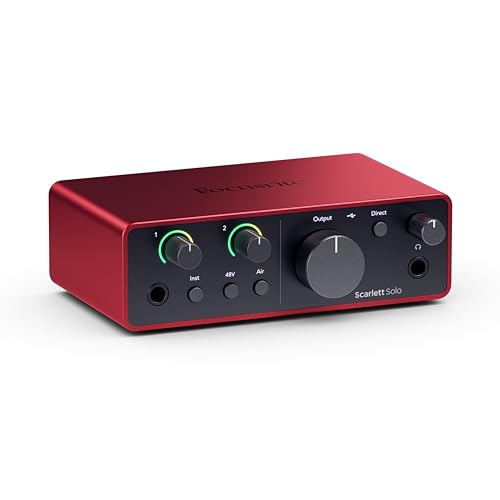
Focusrite Scarlett Solo 4th Gen USB Audio Interface, for the Guitarist, Vocalist, or Producer...
- The new generation of the songwriter's interface: Plug in your mic and guitar and let Scarlett Solo 4th Gen bring big studio sound to wherever you make music
- Studio-quality sound: With a huge 120dB dynamic range, the newest generation of Scarlett uses the same converters as Focusrite’s flagship interfaces, found in the...
- Find your signature sound: Scarlett 4th Gen's improved Air mode lifts vocals and guitars to the front of the mix, adding musical presence and rich harmonic drive to your...

If you’re a guitarist or vocalist looking for a solid audio interface, the Focusrite Scarlett Solo 4th Gen USB Audio Interface could be your new best friend. Weighing just 14.4 ounces and measuring 1.79 x 5.63 x 3.78 inches, it’s compact yet powerful. This beauty offers studio-grade converters with a dynamic range of 120dB. You’ll love the improved Air mode, which cranks up the vocal and guitar quality, making you sound fantastic. Plus, it comes with a complete recording software bundle. With 24/7 support and a warranty, it’s a smart investment. Trust me, your recordings just got a major upgrade!
Best For: The Focusrite Scarlett Solo 4th Gen USB Audio Interface is best for guitarists, vocalists, and producers seeking high-quality recording equipment.
Pros:
- Studio-grade converters with a dynamic range of 120dB for professional audio quality.
- Improved Air mode enhances sounds, adding richness to vocals and guitars.
- Comprehensive software bundle and 24/7 technical support for peace of mind.
Cons:
- Limited to two inputs, which may not suffice for larger recording setups.
- USB-C connection may require adapters for older devices.
- Some users may find the setup process complicated despite the Easy Start feature.
TASCAM Mixcast 4 Podcast Streaming Mixer and Recorder

TASCAM Mixcast 4 Podcast Streaming Mixer, Recorder, and USB Audio Interface — Four XLR/TRS Mic...
- Features: Mixcast 4 makes professional content creation easy. For podcast creation, live streaming, event production or voice-over, Mixcast 4 can mix and record mic input...
- Versatile: From audio recording to the mixing of recorded audio, the Mixcast 4 offers a complete production environment with multiple convenient functions such as...
- Stress-Free Touch Panel Control: Equipped with four mic inputs and four individual headphones outputs, the Mixcast 4 is always ready for podcast production without...
The TASCAM Mixcast 4 is an excellent choice for podcasters and live streamers looking for a simple yet powerful mixer. It features four XLR/TRS mic inputs and a hassle-free touch screen, making it user-friendly. With its ability to mix mic input with background music, sound effects, and jingles via trigger pads, you can create engaging content without breaking a sweat. You’ll appreciate recording directly to an SD card or using the Bluetooth audio input for phone calls. Plus, the included Tascam Podcast Editor simplifies your post-production process. Honestly, it’s hard to find an easier way to elevate your podcasts!
Best For: The TASCAM Mixcast 4 is best for podcasters and live streamers seeking a user-friendly mixer that simplifies the content creation process.
Pros:
- Ease of use with a stress-free touch panel control for seamless operation.
- Four XLR/TRS mic inputs and headphone outputs allow for simultaneous use without complex setups.
- Includes Tascam Podcast Editor for straightforward audio editing and track management.
Cons:
- Might be overwhelming for beginners who are not familiar with audio mixing technology.
- Limited to four mic inputs, which may not suffice for larger group podcasts or events.
- Some users may find the sound pad customization options initially confusing.
PreSonus Quantum ES 4 USB-C Audio Interface
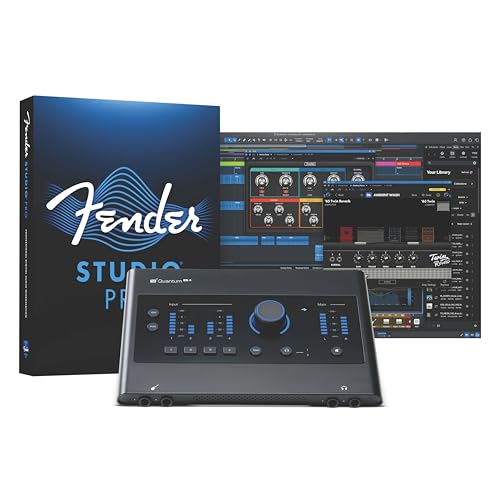
PreSonus Quantum ES 4 4 x 4, 24-bit / 192 kHz USB-C Audio Interface with Fender Studio Pro Software
- HIGH PERFORMANCE SIGNAL FLOW. Our custom low-latency driver provides exceptionally low audio latencies when recording, and high-performance converters complete the front...
- ALL-NEW MAX-HD MIC PREAMPS. The Quantum ES 4 features four newly designed mic preamps with +75 dB of gain. Our high-definition MAX-HD preamps are transparent, low-noise...
- CO-DEVELOPED WITH FENDER. Built by the best ears in the business, guitarists and bassists will love the instrument input co-developed with Fender engineers – industry...
Meet the PreSonus Quantum ES 4 USB-C Audio Interface, ideal for musicians and producers who crave exceptional audio quality without breaking the bank. With a 24-bit/192 kHz sample rate, your recordings will sound outstanding. It features four new MAX-HD preamps, offering +75 dB gain and low noise. Plus, the custom low-latency driver means you won’t be pulling your hair out waiting for audio! Co-developed with Fender, guitarists and bassists will appreciate the tailored instrument input—it’s like a match made in audio heaven. Weighing just 1.8 pounds, this interface packs a punch in a small package! What’s not to love?
Best For: Musicians and producers seeking high-quality audio recording in a compact and affordable audio interface.
Pros:
- High-Performance Audio Quality: Offers 24-bit/192 kHz sample rate with advanced converters and MAX-HD preamps for exceptional sound.
- Low Latency: Custom low-latency driver ensures minimal delay during recording, enhancing the user experience.
- User-Friendly Controls: Gain staging and preamp functions can be adjusted through the top panel or the Universal Control app for convenience.
Cons:
- Limited I/O Channels: As a 4 x 4 interface, it may not suffice for larger recording setups that require more input channels.
- Dependence on Software: Some users may need compatible software for full functionality, which could require additional purchases.
- Mobile Flexibility: While compatible with mobile devices, the experience may not match that of using a desktop setup.
M-AUDIO M-Track Duo USB Audio Interface for Recording and Streaming
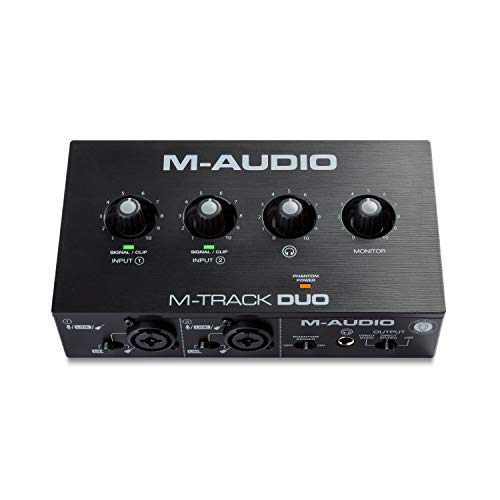
M-AUDIO M-Track Duo USB Audio Interface for Recording, Streaming and Podcasting with Dual XLR, Line...
- Podcast, Record, Live Stream, This Portable Audio Interface Covers it All - USB sound card for Mac or PC delivers 48kHz audio resolution for pristine recording every time
- Be ready for anything with this versatile M-AUDIO interface - Record guitar, vocals or line input signals with two combo XLR / Line / Instrument Inputs with phantom power
- Everything you Demand from an Audio Interface for Fuss-Free Monitoring - 1/4" headphone output and stereo 1/4" outputs for total monitoring flexibility; USB/Direct switch...
For anyone diving into recording, streaming, or podcasting, the M-AUDIO M-Track Duo USB Audio Interface is a fantastic companion. Weighing just 12.7 ounces and measuring 4.34 x 7.5 x 2.13 inches, it fits snugly on any desk. With dual combo inputs that support microphones, instruments, and line levels, you’re all set for diverse setups. Plus, it offers 48 kHz audio quality and zero-latency monitoring for crystal-clear performance. You’ll also love the included MPC Beats software. With a solid 4.5-star rating, it’s no surprise this interface flies off the shelves. Grab yours and elevate your sound game!
Best For: Those looking to enhance their recording, streaming, or podcasting experience with a compact and versatile audio interface.
Pros:
- User-friendly: Easy to set up and compatible with both Mac and PC.
- Versatile Inputs: Supports microphones, line-level devices, and instruments for diverse recording needs.
- Zero-Latency Monitoring: Allows for real-time audio monitoring, ensuring better performance during recording.
Cons:
- Limited Audio Resolution: Maxes out at 48 kHz, which may not meet the needs of high-end recording professionals.
- No MIDI Inputs: Lacks direct MIDI input options, restricting integration with MIDI devices.
- Basic Software Bundle: While it includes MPC Beats, some may prefer more advanced DAW options.
Focusrite Scarlett 4i4 USB Audio Interface for Musicians and Creators
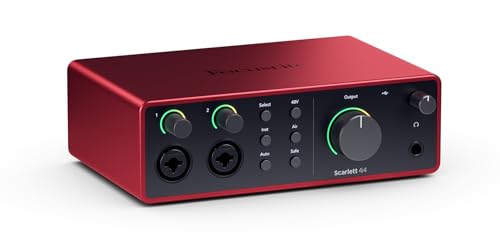
Focusrite Scarlett 4i4 4th Gen USB Audio Interface, for Musicians, Songwriters, Guitarists, Content...
- The new generation of the music maker's studio hub: Connect your mics, guitars, synths and drum machines to Scarlett 4i4 4th Gen and get audio performance that matches...
- A new generation - ready for all your gear: Two Scarlett 4th Gen mic preamps. Two Hi-Z instrument inputs. 4 line inputs. 4 line outputs. And MIDI I/O
- Studio-quality sound: With a huge 120dB dynamic range, Scarlett 4th Gen uses the same converters as Focusrite’s flagship interfaces, found in the world's biggest...
Looking to take your music production to the next level? The Focusrite Scarlett 4i4 USB Audio Interface is just what you need. It packs two high-quality mic preamps and two Hi-Z instrument inputs, perfect for musicians and creators alike. You’ll enjoy studio-quality sound with a 120dB dynamic range, making your recordings shine. Plus, features like Air mode enhance your vocals and instruments effortlessly. With included software like Pro Tools Intro+ and Ableton Live Lite, you’ll have everything you need to jumpstart your projects. So go ahead, plug in, and let your creativity flow—just don’t forget the snacks!
Best For: Musicians, songwriters, guitarists, and content creators looking for a high-quality audio interface for recording and production.
Pros:
- High-fidelity sound with a 120dB dynamic range.
- Two Scarlett 4th Gen mic preamps and Hi-Z instrument inputs for versatile recording options.
- Comes with essential software like Pro Tools Intro+ and Ableton Live Lite, ideal for starting music production.
Cons:
- May require additional gear for full functionality (such as mics and instruments).
- Limited number of inputs and outputs compared to larger audio interfaces, which may not suit all needs.
- Bundled software options may vary in efficacy depending on user experience and preferences.
Zoom AMS-44 USB Audio Interface

Zoom AMS-44 USB Audio Interface for Musicians & Podcasters, with 4 Inputs, 4 Outputs, Loopback...
- FOUR INPUTS, FOUR OUTPUTS, ZERO HASSLE – Features four XLR/TRS combo inputs with four low-noise preamps and 48V phantom power, delivering professional-quality audio...
- ONE SWITCH BETWEEN STUDIO AND STREAM MODE – Toggle instantly between Music mode for independent input routing and DAW recording and Streaming mode that combines all...
- MONITOR AND LOOP BACK WITHOUT EXTRA SOFTWARE – Monitor your input signal in real time with zero latency using the Direct Monitor switch, and combine input audio with...
If you’re diving into the world of audio production, the Zoom AMS-44 USB Audio Interface is a fantastic choice that combines quality and versatility. Weighing just 12.5 ounces and measuring 6.1 x 5.63 x 2.28 inches, it’s lightweight and fits right into your gear bag. With 4 inputs and outputs, it covers plenty of audio setups, whether you’re recording with friends or flying solo. Its USB Type-C connectivity guarantees low latency and high-quality 24-bit/96 kHz recordings. Plus, it works seamlessly across PC, Mac, iOS, and Android. At a 4.4-star rating, it’s clearly a hit! What’s not to love?
Best For: The Zoom AMS-44 USB Audio Interface is best for musicians, podcasters, and content creators seeking a high-quality, portable audio interface for professional-grade recordings.
Pros:
- High audio quality with 24-bit/96 kHz resolution for professional recordings and monitoring.
- Versatile connectivity options including USB Type-C and compatibility with various operating systems and software.
- Compact and lightweight design makes it easy to transport and integrate into any setup.
Cons:
- Limited to 4 inputs and outputs, which may not be sufficient for larger projects needing more channels.
- USB 2.0 connectivity may not be as fast as newer interfaces using USB 3.0 or higher.
- Some users may experience a learning curve with setup and software integration for optimal performance.
M-Audio AIR 192×14 USB Audio Interface for Studio Recording
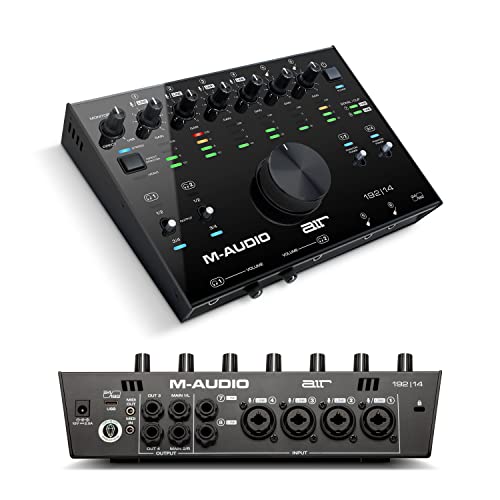
M-AUDIO AIR 192x14 USB-C Audio Interface for Studio Recording with 8 In and 4 Out, MIDI...
- Capture every detail - premium component selection and 24-bit/192kHz resolution for professional recording and monitoring to your Mac/ PC;
- Low latency - Hi-Speed USB/ USB-C circuitry gives you the fastest connection, with a class-leading round trip latency of only 2. 59Ms; USB and USB-C connection cables...
- Pristine studio grade capture - transparent crystal preamps and ultra-pristine ad converters for unsurpassed audio recording quality
The M-Audio AIR 192×14 USB Audio Interface is an excellent choice for musicians and producers who crave high-quality sound without breaking the bank. With 8 inputs and 4 outputs, it’s perfect for recording sessions that need a bit of everything. You’ll love the crystal-clear audio, thanks to its 24-bit/192kHz resolution and low latency of 2.59ms. Plus, there are plenty of connectivity options, including MIDI in/out, and two headphone outputs for those late-night jam sessions. Don’t forget the bundled software like MPC Beats and Ableton Live Lite—ideal for kickstarting your musical creativity. Who knew recording could be this fun?
Best For: Musicians and producers seeking a budget-friendly audio interface that delivers professional sound quality and versatile connectivity options.
Pros:
- High audio resolution of 24-bit/192kHz ensures studio-quality recordings.
- Low latency performance at 2.59ms provides a seamless recording experience.
- Includes a robust software bundle featuring popular music production tools like MPC Beats and Ableton Live Lite.
Cons:
- Limited to 8 inputs, which may not suffice for larger recording setups.
- Weighs almost 4 pounds, which could be considered less portable for on-the-go recording.
- Some users may find the included software less comprehensive compared to other premium offerings.
Zoom PodTrak P4 Podcast Recorder
Sale

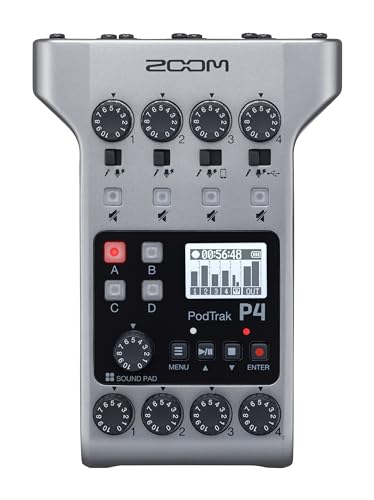
Zoom PodTrak P4 Podcast Recorder with 4 XLR Mic Inputs, 4 Headphone Outputs, Phone & USB Input for...
- 4 high quality microphone inputs with phantom power
- 4 headphone outputs with individual volume control
- 4 programable Sound Pads + multi-track recording for all inputs and Sound Pads
For podcasters and musicians on the go, the Zoom PodTrak P4 Podcast Recorder is a game-changer. It’s battery-powered, letting you record anywhere without hunting for an outlet. With four high-quality mic inputs that have phantom power, you’re set for crisp audio. Want to chat remotely? Just use the TRRS jack or USB. Plus, you get four headphone outputs with individual volume controls—perfect for group sessions. The four programmable sound pads add fun sound effects that can spice up your recording. With 3.5 hours of battery life on just two AA batteries, you’ll definitely outlast your guests. How cool is that?
Best For: The Zoom PodTrak P4 Podcast Recorder is best for podcasters and musicians who need a portable, user-friendly recording solution for interviews and sessions on the go.
Pros:
- Battery-powered design allows for recording in various locations without needing an outlet.
- High-quality microphone inputs with phantom power ensure excellent audio quality.
- Four programmable sound pads let users add entertaining sound effects during recordings.
Cons:
- Limited battery life of up to 3.5 hours may not be sufficient for longer recording sessions.
- Only two AA batteries limit power options compared to devices with rechargeable batteries.
- Lack of onboard storage means users must rely on SD cards for recording, which requires additional purchases.
Focusrite Scarlett 18i16 USB Audio Interface for Music Production
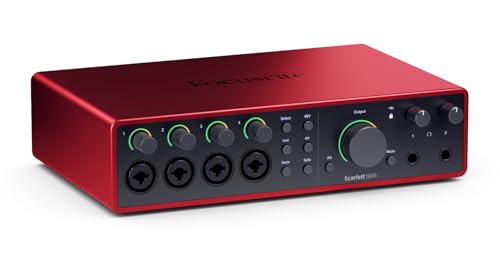
Focusrite Scarlett 18i16 4th Gen USB Audio Interface, for Songwriting, Music Production, Recording...
- The producer's interface: Scarlett 18i16 features 18 inputs and 16 outputs, including four mic preamps, Hi-Z, line inputs, ADAT, S/PDIF, and MIDI I/O
- Capture everything: The 4th Generation preamps provide 69dB of gain, with two Hi-Z inputs and eight line inputs for versatile connectivity
- Audio quality beyond its class: Equipped with 24-bit, 192kHz converters from our flapship RedNet range, offering a 122dB dynamic range for detailed recordings
Ready to elevate your music production game? The Focusrite Scarlett 18i16 USB Audio Interface could be your new best buddy! With 18 inputs and 16 outputs, it’s perfect for all sorts of setups. It features four high-quality mic preamps and offers two Hi-Z inputs for guitars—no more fighting for channels!
You’ll get stunning audio at 24-bit, 192 kHz quality. Plus, the Air mode enhances your recordings, adding that special studio vibe we all love. And don’t forget the included software! With Pro Tools Intro+ and more, you’ll be swiftly creating tracks in no time—coffee not included!
Best For: The Focusrite Scarlett 18i16 is best for musicians, producers, and podcasters looking for a versatile and high-quality audio interface to enhance their recording capabilities.
Pros:
- High-quality 24-bit, 192 kHz audio converters for exceptional sound.
- Versatile connectivity with multiple inputs including mic preamps, Hi-Z, and line inputs.
- Includes a comprehensive software bundle for music production, making it an all-in-one solution.
Cons:
- Slightly bulky, which may be cumbersome for portable setups.
- Some users may find the learning curve steep for advanced features.
- Price point may be higher compared to basic audio interfaces, potentially limiting budget-conscious users.
Tascam US-4x4HR USB Audio Interface for Recording and Streaming

Tascam US-4x4HR 4 Mic 4IN/4OUT High Resolution Versatile USB Audio Interface for Recording...
- 4-in/4-out USB audio interface
- Supports up to 24-bit/ 192kHz audio formats
- Improved TASCAM driver with selectable buffer size from 4 samples provides low-latency and stability (Windows: TASCAM native driver)
Looking to level up your recording game? The Tascam US-4x4HR USB Audio Interface could be just what you need. With four XLR/TRS combo inputs and Ultra-HDDA mic preamps, you can capture crystal-clear sound. It supports 24-bit/192kHz audio formats, ensuring high-res quality for your projects, whether you’re recording or streaming. You’ll love the low-latency performance from its improved driver—buffer sizes as small as four samples mean no annoying lag. Plus, the phantom power lets your mics shine. Perfect for musicians, podcasters, and those who love a good jam session, this interface won’t let you down. Happy recording!
Best For: Musicians, podcasters, and streamers looking for a high-quality audio interface to enhance their recording and streaming experiences.
Pros:
- Crystal-clear sound with four XLR/TRS combo inputs and Ultra-HDDA mic preamps.
- Supports high-resolution audio formats up to 24-bit/192kHz for professional-quality recordings.
- Low-latency performance with selectable buffer sizes, ensuring efficient workflow during recordings.
Cons:
- Limited to USB connectivity, which may not appeal to users who prefer other connection types.
- Higher price point compared to entry-level interfaces may be a barrier for beginners.
- Compatibility issues with non-Windows operating systems, as it requires TASCAM native drivers for optimal performance.
Factors to Consider When Choosing a Four Input Audio Interface

When you’re picking a four-input audio interface, there are a few key factors to keep in mind. Audio quality standards, input and output options, and software compatibility can make or break your recording experience. Plus, don’t forget about the build design and latency performance—after all, nobody wants to sound like they’re echoing from a cave!
Audio Quality Standards
Choosing the right audio interface can feel overwhelming, but understanding audio quality standards makes the journey easier. Look for a 24-bit resolution and sample rates that max out at 192 kHz; that’s where the magic happens. You want at least a 120dB dynamic range, too, to keep your audio clean—who wants noisy recordings? High-performance converters are a game-changer, guaranteeing your recordings have that professional warmth. Plus, low latency and direct monitoring are essential for musicians and podcasters who need instant feedback during recording—nobody wants to wait around! Finally, verify your interface works with multiple software and operating systems; versatility is key. Trust me, it’ll save you headaches later on!
Input and Output Options
Input and output options play a crucial role in making your four-input audio interface the right fit for your musical needs. Look for interfaces featuring multiple input options like XLR/TRS combo jacks; they let you plug in various microphones and instruments at once. If you’re connecting electric guitars or basses, you’ll want dedicated Hi-Z inputs for maximum signal quality. MIDI I/O capabilities are also key; they’ll help connect synthesizers and expand your studio’s versatility. Check the number of outputs too—having enough allows for better monitoring options. And don’t forget phantom power, especially if you’re using condenser mics; they need that +48V to function properly. Your audio interface should do heavy lifting, not the other way around!
Software Compatibility
Software compatibility can make or break your experience with a four-input audio interface. You’ll want to check if it works smoothly with popular digital audio workstations (DAWs) like Pro Tools, Ableton Live, or FL Studio. This matters—trust me! Many interfaces also come with software bundles that offer tools for recording, editing, or mixing. Plus, make sure it supports your operating system, whether you’re a Windows or macOS user, to dodge any frustrating issues. Don’t forget to look for drivers and software utilities that can boost performance—who doesn’t want to manage latency better? Finally, try reading user reviews on setup experiences; they’re gold for understanding the real-world reliability of your chosen interface. Happy hunting!
Build and Design
Now that you’ve picked an audio interface compatible with your favorite software, let’s talk about build and design—an often overlooked yet super important factor. Think about portability: you’ll find options weighing from 12 ounces to nearly 4 pounds. If you’re on the go, a compact design around 6 to 8 inches wide is perfect for fitting into your gear bag. Check the materials too; interfaces made from sturdy plastics or metals can handle travel wear and tear. Ergonomics matter, too—inputs and controls should be easy to access, making life simpler during recordings. Features like LED metering for input levels? They’re a game-changer for monitoring audio performance. Don’t underestimate the importance of a solid design; it can make all the difference!
Latency Performance
When you’re diving into the world of audio interfaces, latency performance is something you can’t ignore—trust us, it can make or break your recording experience. Ideally, you want your round trip latency below 5 milliseconds for professional-grade sound. That way, you can record and monitor in real-time without feeling like you’re in a time warp—no fun, right? Look for interfaces with optimized USB drivers, especially if you’re working with high-resolution audio formats like 24-bit/192kHz. Direct monitoring features are a huge plus, letting you hear inputs instantly. And don’t forget adjustable buffer sizes! They help you balance low latency with your computer’s workload. So, keep these factors in mind to optimize your performance and workflow. Happy recording!
Connectivity Features
Choosing the right connectivity features for your four-input audio interface can feel overwhelming, especially with so many options available. Start by looking for USB connectivity, like USB-C, which offers faster data transfers and fits modern devices. You’ll want to guarantee your interface supports multiple input types—think XLR, TRS, and Hi-Z—for different microphones and instruments. MIDI I/O ports are a huge bonus for connecting keyboards or synths, too. Plus, don’t forget to check for extra audio outputs; monitoring through studio monitors or headphones can save you extra gear. Finally, make certain it’s compatible with your operating system—Windows, Mac, or even iOS—to keep everything running smoothly. Happy hunting!
Frequently Asked Questions
What Are the Best Audio Interfaces for Live Performances?
For live performances, you’ll love the Focusrite Scarlett 18i8. It’s got four inputs, costs around $399, and offers great sound quality. The PreSonus Studio 68c is another solid choice, priced at about $199; it features two combo inputs and MIDI in/out. If you want something lightweight, the IK Multimedia iRig Pro I/O is perfect at just $199, and fits in your backpack. Seriously, your audience will thank you for that excellent sound!
Can I Use an Audio Interface Without a Computer?
Yep, you can totally use an audio interface without a computer! Many interfaces work with tablets or smartphones, letting you capture sound on the go. Just check if your device can connect via USB or Bluetooth, and find an app that supports it, like GarageBand or FL Studio. You’ll want one with enough inputs for your gear, like a 4-input model. So, grab your gear, and let the creativity flow!
What Cables Are Required for Four-Input Audio Interfaces?
To connect your four-input audio interface, you’ll need a mix of cables, including XLR cables for microphones, TRS or TS cables for instruments, and sometimes MIDI cables if you’re adding external gear. XLR cables usually run about $15 each, and you can find TRS cables for around $10. Just remember, the right connections make all the difference in sound quality. So, don’t skimp on those cables, unless you like a surprise fuzz!
How Do I Troubleshoot Common Issues With Audio Interfaces?
To troubleshoot common issues with audio interfaces, start by checking your cables—make sure they’re plugged in securely. Next, verify your interface is selected as your audio input and output device in your software settings. If the sound’s glitchy, try lowering the buffer size; it helps with latency. Restarting everything might fix the problem too. Finally, update drivers regularly—firmware updates are like vitamins for your tech! Got it? You’re almost an audio superhero!
Are There Specific Audio Interfaces for Mobile Recording?
Absolutely, there are great audio interfaces for mobile recording! Imagine capturing studio-quality sound on the go—pretty exciting, right? Look for portable options like Focusrite Scarlett Solo or PreSonus AudioBox iTwo, both around $100. They’re compact, USB powered, and super easy to use. Plus, they offer excellent preamps, which make your recordings shine. Just think, you could be jamming in a park instead of your bedroom! Who wouldn’t want that?


