As an Amazon Associate, we earn from qualifying purchases. Some links on this site are affiliate links at no extra cost to you. Our recommendations are based on thorough research and editorial judgment.


10 Best Audio Interfaces for Podcasting: Unlock Professional Sound Quality

Looking for the best audio interfaces for your podcast? You’ve got great options! Try the MAONO AME2 for its lightweight design and excellent sound quality, or the Focusrite Scarlett 2i2 for studio-grade performance. The M-AUDIO M-Track Duo is easy to use, making it perfect for beginners. Don’t forget the PUPGSIS mixer, ideal for streamers too! With a range of features, there’s something for everyone, and you’ll find even more tips and tricks just ahead!
Key Takeaways
- Look for audio interfaces with built-in preamps and phantom power to enhance the quality of podcast recordings.
- Choose devices with zero-latency monitoring for real-time audio feedback during sessions.
- Select interfaces that offer multiple input options, ensuring compatibility with various microphones and instruments.
- Consider compact and lightweight designs for portability, especially for podcasters on the go.
- Check for bundled software that aids in recording and editing, benefiting both beginners and experienced users.
Maono Audio Interface Podcast Mixer (AME2)

MAONO AME2 Audio Interface Mixer, Podcast Studio Console with XLR Input
- [Excellent Performance with Superior Preamp]: AME2 built-in quality preamps support phantom power for optimal performance of XLR microphones. The AME2 features 3-level...
- [Up to 11 Customized Sound Pads to Enhance Your Podcast Atmosphere]: AME2 10-channel podcast mixer allows for 11 customizable sound pads. 3 sound pads support recording...
- [Perfect for Guitar, Bass, and Other Musical Instruments with a 6.35mm Jack]: AME2 is a great option if you are looking for an audio interface to record guitar or bass...
If you’re diving into the world of podcasting, the MAONO Audio Interface Podcast Mixer (AME2) might just be your new best friend. This sleek mixer features built-in preamps and supports phantom power for your XLR microphones, ensuring your sound quality is exceptional. With 11 customizable sound pads and six reverb modes, you can really add flair to your recordings. Plus, it’s compatible with popular mics like the Shure SM7B and Rode Podmic. Weighing only 2.09 pounds and measuring 9.64 x 6.18 inches, it’s portable, too. So, whether you’re live streaming or recording, the AME2 has your back!
Best For: Podcast creators and live streamers looking for a portable, high-quality audio mixer with customizable sound features.
Pros:
- Built-in preamps with phantom power provide excellent sound quality for XLR microphones.
- Customizable sound pads and reverb options enhance creative audio outputs.
- Lightweight and compact design makes it easy to transport for on-the-go recording sessions.
Cons:
- USB microphones are not supported, limiting compatibility with certain models.
- Requires a corded power source, which may restrict mobility in certain setups.
- Some users may find the learning curve steep with various features and settings.
Recommended Products

[XLR Mic Input] One XLR microphone input interface is set on the gaming audio mixer, which is great to up your audio quality with your XLR setup. The XLR mixer is a stepping stone to upgrade your live streaming. Audio mixer offered built-in 48V phantom power which opens up more choices for mics. Directly use it with your condenser microphone but do not solve added peripherals. (NOT available for USB mic)

Upgraded Podcast Equipment Bundle: Elevate your podcasting, streaming, and studio recording with the E2 Gen2 podcast equipment bundle. This all-in-one solution offers an intuitive design that allows you to start your podcasting journey right away. With two XLR combo inputs and a high-quality preamp offering 60dB gain, E2 GEN2 is perfect for co-hosts. Plus, the USB-C and 3.5mm ports make it easy to connect to phones and computers, ensuring smooth and clear audio every time

[4-Channel Design] Featured four individual control channels, the gaming mixer can be individually adjusted different devices. You will gain a improved using experience via push the volume fader.
M-AUDIO M-Track Duo USB Audio Interface for Recording and Streaming
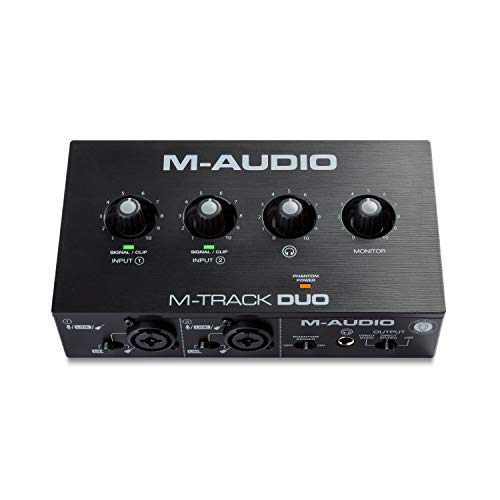
M-AUDIO M-Track Duo USB Audio Interface for Recording, Streaming and Podcasting with Dual XLR, Line...
- Podcast, Record, Live Stream, This Portable Audio Interface Covers it All - USB sound card for Mac or PC delivers 48kHz audio resolution for pristine recording every time
- Be ready for anything with this versatile M-AUDIO interface - Record guitar, vocals or line input signals with two combo XLR / Line / Instrument Inputs with phantom power
- Everything you Demand from an Audio Interface for Fuss-Free Monitoring - 1/4" headphone output and stereo 1/4" outputs for total monitoring flexibility; USB/Direct switch...

The M-AUDIO M-Track Duo USB Audio Interface is a fantastic choice for beginner podcasters who need a reliable, easy-to-use device. With 48 kHz audio resolution, it delivers crisp sound quality you’ll appreciate. Weighing only 12.7 ounces and measuring 4.34 x 7.5 x 2.13 inches, it’s portable enough for your home studio or on-the-go recordings.
It features dual combo inputs for XLR, line, and instrument connections. Plus, it offers zero-latency monitoring—because who wants to hear an echo, right? You’ll also enjoy included software like MPC Beats and a subscription to Reason+. Give it a try; your audience will thank you!
Best For: Beginner podcasters looking for a reliable and portable audio interface for recording and streaming.
Pros:
- Dual combo inputs for versatility with XLR, line, and instrument connections.
- Zero-latency monitoring for real-time audio feedback without echo.
- Includes software like MPC Beats and a subscription to Reason+, enhancing your creative options.
Cons:
- Limited to 48 kHz audio resolution, which may not satisfy professional users.
- Some users may find the compact size limiting for workspace layout.
- Phantom power may not support all condenser microphones, depending on their requirements.
Recommended Products
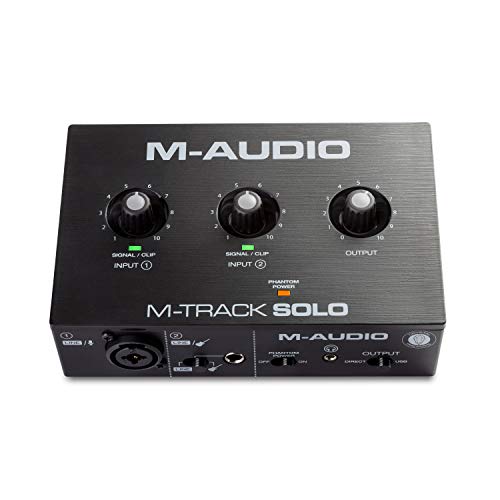
Podcast, Record, Live Stream, This Portable Audio Interface Covers it All - USB sound card for Mac or PC delivers 48kHz audio resolution for pristine recording every time

Podcast, Record, Live Stream, This Portable Audio Interface Covers it All - USB sound card for Mac or PC delivers 48kHz audio resolution for pristine recording every time

Pro performance with great pre-amps - Achieve a brighter recording thanks to the high performing mic pre-amps of the Scarlett 3rd Gen. A switchable Air mode will add extra clarity to your acoustic instruments when recording with your Solo 3rd Gen
Focusrite Scarlett 2i2 4th Gen USB Audio Interface

Focusrite Scarlett 2i2 4th Gen USB Audio Interface for Recording, Songwriting, Streaming and...
- The new generation of the artist's interface: Connect your mic to Scarlett's 4th Gen mic pres. Plug in your guitar. Fire up the included software. Start making your first...
- Studio-quality sound: With a huge 120dB dynamic range, the newest generation of Scarlett uses the same converters as Focusrite’s flagship interfaces, found in the...
- Never lose a great take: Scarlett 4th Gen's Auto Gain sets the perfect level for your mic or guitar, and Clip Safe prevents clipping, so you can focus on the music
For aspiring podcasters and musicians, the Focusrite Scarlett 2i2 4th Gen USB Audio Interface is a game-changer. Weighing just 1.73 pounds and measuring 7.09 x 3.9 x 1.79 inches, it offers professional sound quality without cramping your style. With ultra-low-noise mic pres, you’ll capture clear vocals and guitar tones effortlessly. Plus, its studio-grade converters and 120dB dynamic range deliver rich, crisp sound. The Auto Gain feature guarantees optimal levels, while Clip Safe prevents awkward audio mishaps. Compatible with multiple devices and operating systems, this affordable powerhouse also comes with software like Pro Tools Intro and a three-year warranty. Who doesn’t love that?
Best For: The Focusrite Scarlett 2i2 4th Gen USB Audio Interface is best for aspiring podcasters, musicians, and content creators seeking high-quality audio recording.
Pros:
- Ultra-low noise mic pres ensure clear vocals and instrument tones.
- Studio-grade converters provide a 120dB dynamic range for rich sound quality.
- Comes with a comprehensive software bundle, including Pro Tools Intro and FL Studio.
Cons:
- Limited to USB-C connectivity, which may require adapters for older devices.
- Some users may find the software options overwhelming or unnecessary for their needs.
- The compact size may not allow for extensive connectivity options compared to larger interfaces.
Recommended Products

USB Audio Interface: Podcast, Record, Live Stream, This Portable Audio Interface Covers it All – USB sound card for Mac or PC delivers 48 kHz audio resolution for pristine recording every time.
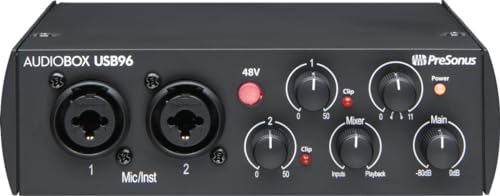
Value-packed 2-channel USB 2.0 interface for personal and portable recording.

✔️[High-fidelity sound quality, accurate sampling] The Synido 2x2 audio interface uses a high-quality independent audio chip to reduce recording latency, support 24-bit depth and 48kHz sampling rate, and ensure every detail is restored. Whether it is recording or live broadcasting, it can provide a clear and natural sound quality experience
PUPGSIS Gaming Audio Mixer for PC/Streaming
Sale


PUPGSIS Gaming Audio Mixer, Audio Interface for PC/Podcast/Streaming, Sound Board with 3.5mm/XLR Mic...
- Power Up Your Voice: Equipped with a professional preamplifier and 48V phantom power, the audio mixer works perfectly with your favorite XLR microphone to deliver...
- Customize Your Audio: This gaming audio mixer features six voice-changing modes, allowing you to easily experiment with different sounds or add a touch of humor to your...
- Individual Channel Controls: The DJ mixer has a simple and intuitive interface for easy operation. Four smooth volume faders independently control the levels for Mic...
Looking to level up your podcast or streaming game? The PUPGSIS Gaming Audio Mixer packs a punch with its versatile features. It comes with a 3.5mm/XLR mic input, 48V phantom power, and Bluetooth connectivity. Weighing just 1.28 pounds, it measures 6 x 5 x 2 inches—perfect for your desk! With clear audio output and six voice-changing modes, you can get creative or just have a little fun. Plus, it supports up to three microphones, so no guest gets left out. Rated 4.4 stars, it’s a top choice for seamless streaming on platforms like Twitch and Zoom. Why not give it a shot?
Best For: Content creators, podcasters, and streamers looking for a versatile audio mixing solution that enhances sound quality and allows for multiple microphone inputs.
Pros:
- High-quality audio output with professional preamplifier and 48V phantom power for XLR microphones.
- Intuitive user interface with volume faders and a clear display for easy control during live sessions.
- Versatile connectivity options including Bluetooth and compatibility with popular streaming platforms like OBS, Discord, and Twitch.
Cons:
- Corded electric design may limit mobility for users who prefer wireless setups.
- Limited to 3 microphone inputs, which may not suffice for larger groups or events.
- Physical size (6 x 5 x 2 inches) may be less compact for users with minimal desk space.
Recommended Products

INDIVIDUAL CONTROLS: Volume slider with mute buttons for Mic/Headphones/Line in/Line out.

【Podcast Equipment Bundle】The podcast microphone bundle includes everything you need for professional-quality audio creation: a 3.5mm condenser microphone with a boom arm and the Sound Board. Perfect for podcasters, gamers, streamers, and content creators who want an all-in-one solution for mixing, recording, and streaming

Upgrade Mic Clarity with XLR Power-Unlock studio-quality voice capture: The 48V phantom power XLR port supports high-sensitivity mics up to -50dB gain, while the Dynamic/Condenser toggle adapts to any microphone type. With <0.2% distortion and 75dB SNR, your comms cut through explosions crisply. Adjust mic monitoring via output knob on the gaming mixer keeping you aware of voice levels—perfect for intense FPS callouts.
M-AUDIO M-Track Solo USB Audio Interface for Recording, Streaming, and Podcasting
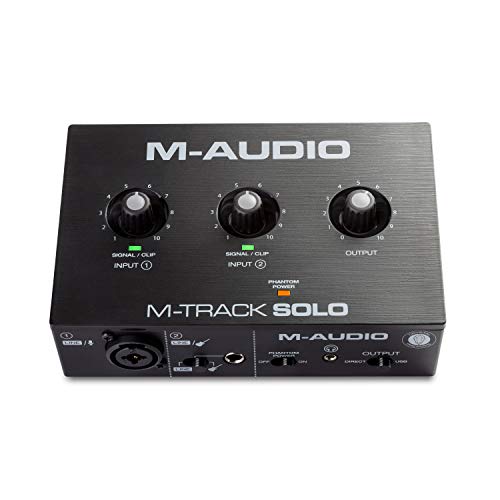
M-AUDIO M-Track Solo USB Audio Interface for Recording, Streaming and Podcasting with XLR, Line and...
- Podcast, Record, Live Stream, This Portable Audio Interface Covers it All - USB sound card for Mac or PC delivers 48kHz audio resolution for pristine recording every time
- Be ready for anything with this versatile M-AUDIO interface - Record guitar, vocals or line input signals with one combo XLR / Line Input with phantom power and one Line...
- Everything you Demand from an Audio Interface for Fuss-Free Monitoring - 1/8" headphone output and stereo RCA outputs for total monitoring flexibility; USB/Direct switch...
If you’re diving into the world of podcasting or online streaming, the M-AUDIO M-Track Solo USB Audio Interface might just be your new best buddy. This portable device brings 48kHz audio resolution, ensuring your recordings sound crisp on both Mac and PC. With one combo XLR/Line input and an additional Line/Instrument input, you can easily connect your guitar or microphone. It’s super user-friendly, featuring a USB/Direct switch for zero-latency monitoring—perfect for keeping your audio in sync. Plus, it comes with MPC Beats Software, so you can start creating right away. Weighing only 10.6 ounces, it’s travel-friendly too!
Best For: The M-AUDIO M-Track Solo is best for podcasters, streamers, and musicians seeking a reliable, portable audio interface for high-quality recordings.
Pros:
- Compact and portable design, making it easy to record on-the-go.
- Zero-latency monitoring feature allows for real-time audio tracking without delays.
- Comes bundled with MPC Beats Software and other compatible programs, enabling immediate use for music production.
Cons:
- Limited to one combo XLR/Line input, which may not suffice for larger setups requiring multiple inputs.
- The headphone output may not support higher impedance headphones, affecting audio quality for some users.
- May require additional adapters for certain connection types that are not natively supported.
Recommended Products

[5-In-1 Audio Hub] - Cubilux CB5 USB Audio Interface converts the USB port of your laptop into 2 stereo microphone jacks, 1 line-in jack, 1 line-out jack, and 1 headphone jack, letting you conveniently connect microphones, instruments, and headphones or speakers as needed. Please note that the line-out jack and the audio output jack cannot be used simultaneously.
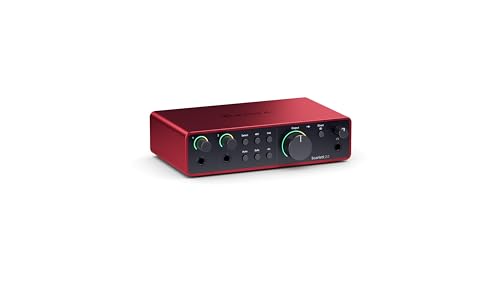
The new generation of the artist's interface: Connect your mic to Scarlett's 4th Gen mic pres. Plug in your guitar. Fire up the included software. Start making your first big hit

Essential Kit for Streaming Setup: MAONOCASTER G1 NEO is the essential gear for gamers and up-and-coming streamers diving into the world of gaming streaming. This gaming mixer not only delivers outstanding sound performance but also integrates customized sound effects and captivating RGB lighting to immerse you in gaming or streaming. Its compact design and user-friendly interface provide an enjoyable and easier gaming experience, making it easier for you to achieve victory
Behringer U-PHORIA UM2 Audiophile USB Audio Interface

Behringer U-PHORIA UM2 Audiophile 2x2 USB Audio Interface with XENYX Mic Preamplifier | for...
- STUDIO IN A LITTLE BLACK BOX: When creativity strikes, you need a fast and easy way to get those musical ideas into your Mac or Windows computer. The easy-to-use UM2 is...
- SEAMLESS INTEGRATION WITH POPULAR DAWS: The ultra-compact UM2 is totally compatible with virtually all popular recording software including Avid Pro Tools, Ableton Live...
- SONICALLY SUPERIOR MIC PREAMP: The studio-grade XENYX mic preamp used in the UM2 offers a staggering 100 dB dynamic range, with a bandwidth that extends from 10 Hz to...
The Behringer U-PHORIA UM2 Audiophile USB Audio Interface is your go-to solution for high-quality podcasting on a budget. Weighing just 9.1 ounces and measuring 6.3 x 8.27 x 3.54 inches, it’s super portable. With a studio-grade XENYX mic preamplifier and 100 dB dynamic range, you’ll capture clear audio without breaking the bank. You’ll find direct monitoring capabilities essential for precise recordings. Plus, it’s compatible with major DAWs like Pro Tools and works seamlessly with both Windows and macOS. At a price you can afford, this interface might just be your new secret weapon in podcasting—so why not give it a try?
Best For: The Behringer U-PHORIA UM2 is best for budget-conscious podcasters and solo musicians looking for a high-quality audio interface for recording.
Pros:
- Studio-grade XENYX mic preamplifier for clear audio capture.
- Ultra-compact design allows for easy portability.
- Direct monitoring capability ensures precise recordings.
Cons:
- Limited to two inputs, which may not be sufficient for larger setups.
- Some users may find the headphone output less powerful than desired.
- May require additional software setup for optimal performance.
Focusrite Scarlett Solo 4th Gen USB Audio Interface
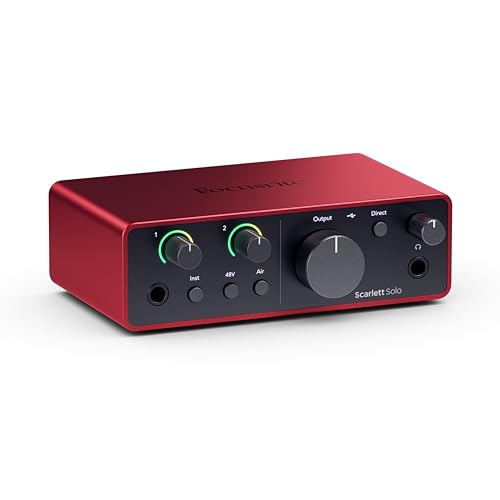
Focusrite Scarlett Solo 4th Gen USB Audio Interface, for the Guitarist, Vocalist, or Producer...
- The new generation of the songwriter's interface: Plug in your mic and guitar and let Scarlett Solo 4th Gen bring big studio sound to wherever you make music
- Studio-quality sound: With a huge 120dB dynamic range, the newest generation of Scarlett uses the same converters as Focusrite’s flagship interfaces, found in the...
- Find your signature sound: Scarlett 4th Gen's improved Air mode lifts vocals and guitars to the front of the mix, adding musical presence and rich harmonic drive to your...
For aspiring podcasters and musicians, the Focusrite Scarlett Solo 4th Gen USB Audio Interface is a fantastic choice. It’s compact, weighing just 14.4 ounces, and fits perfectly on your desk. You’ll enjoy studio-quality recordings thanks to its 120dB dynamic range, which rivals professional equipment. The improved Air mode gives your vocals and guitars a rich, vibrant sound that’ll make you sound pretty awesome. Plus, it comes with software like Pro Tools Intro+ and Ableton Live Lite, so you’re all set for editing. With 24/7 support and a three-year warranty, you’re covered. Let’s create some magic!
Best For: Aspiring podcasters and musicians looking for a high-quality, compact audio interface for their recording needs.
Pros:
- Studio-grade converters provide a 120dB dynamic range for exceptional audio quality.
- Improved Air mode enhances vocal and instrument recordings with added richness.
- Comes bundled with popular recording software, providing a comprehensive toolkit for creative projects.
Cons:
- Limited to a single input for microphones and instruments, which may not suit larger setups.
- May require additional adapters for certain devices if not using USB-C.
- Slightly more expensive than basic audio interfaces, which could be a consideration for beginners on a budget.
Pupgsis Gaming Audio Mixer with Pro-Preamp and Noise Cancellation

Pupgsis Gaming Audio Mixer, Audio Interface for pc,1/4" TRS Dynamic Mic interface,Sound Board With...
- This sound card is not compatible with 48V dynamic microphones or USB microphones. It only supports XLR microphones. (Note: Connecting an XLR microphone requires a...
- 【Studio-Quality Sound for Recording & Streaming】Experience professional-grade audio integrity. Equipped with 6.35mm TRS inputs, this audio interface XLR ensures...
- 【Exceptional Compatibility】The sound board has a clear interface that is widely compatible with phones, computers and tablets. It supports up to 3 microphone audio...
Looking to elevate your podcasting game with a professional touch? The Pupgsis Gaming Audio Mixer is your go-to solution. With its pro preamp and smart noise cancellation, you’ll enjoy crystal-clear audio that’s latency-free. Imagine juggling up to three microphones simultaneously, all while keeping your streams seamless. Plus, it rocks customizable RGB lighting—because who doesn’t love a little flair? Weighing in at just 1.15 lbs, this mixer fits comfortably into your setup. Designed for gamers and podcasters alike, it’s compatible with platforms like OBS, Discord, and Twitch. So, gear up and let your content shine!
Best For: The Pupgsis Gaming Audio Mixer is best for streamers, podcasters, and gamers looking for professional audio quality and a user-friendly setup.
Pros:
- Studio-level audio clarity with latency-free recording and monitoring.
- Intuitive interface with independent faders and mute buttons for easy operation.
- Customizable RGB lighting to enhance the visual experience during streams.
Cons:
- Limited to three microphone inputs, which may not suffice for larger setups.
- Requires a specific compatibility setup with different platforms, which may need technical knowledge.
- May have a learning curve for users unfamiliar with audio mixing equipment.
MAONO USB Audio Interface for PC (PS22 Lite Black)
Sale

MAONO PS22 Lite USB Audio Interface for PC for Guitar & Vocals Streaming
- Capture every detail of your sound: Imagine the perfect take, every note and beat, captured as if by magic. That's the MAONO PS22 Lite audio interface—designed for the...
- For Microphone Lovers: Podcasters and Voice Actors, the PS22 Lite XLR audio interface is perfect. It can handle condenser and dynamic microphones with up to 56 dB of...
- Create Your Music with Guitar: Whether you are a musician or a guitar enthusiast, an interface for recording music gives you rich, realistic sound. Plug into the audio...
If you’re diving into podcasting, the MAONO USB Audio Interface PS22 Lite Black is your new best buddy. Weighing in at just 15.1 ounces, it packs a punch in a compact design. With a crisp 24-bit/192kHz resolution, you can capture every sound detail. Plus, it supports both dynamic and condenser mics, giving you flexibility for different setups. The plug-and-play feature makes connecting it a breeze—just set it and forget it! With a rating of 4.4 stars from happy users, it’s reliable, too. So, say goodbye to mediocre audio and hello to pro-quality sound. Your listeners will thank you!
Best For: The MAONO USB Audio Interface PS22 Lite Black is best for podcasters and home studio enthusiasts seeking high-quality audio recording in a compact and user-friendly design.
Pros:
- High-resolution 24-bit/192kHz recording captures detailed sound.
- Plug-and-play functionality for easy and quick setup.
- Supports both dynamic and condenser microphones with phantom power.
Cons:
- Limited to USB connection, which may not suit all users.
- Some features require compatible software and drivers for full functionality.
- The compact size may not offer extensive controls for advanced users.
FIFINE Gaming Audio Mixer with XLR Microphone Interface
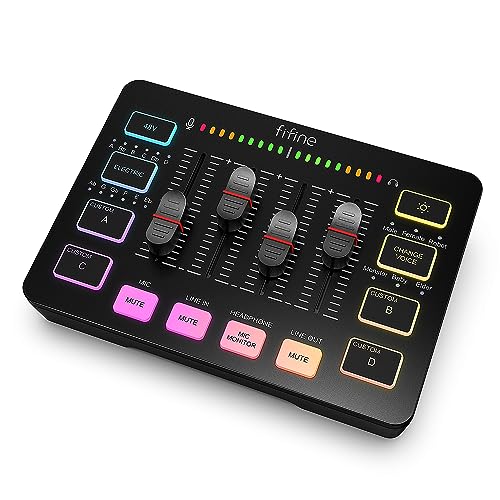
FIFINE Gaming Audio Mixer, Streaming RGB PC Mixer with XLR Microphone Interface, Individual Control...
- [XLR Mic Input] One XLR microphone input interface is set on the gaming audio mixer, which is great to up your audio quality with your XLR setup. The XLR mixer is a...
- [Individual Channel Control] Gaming audio mixer for one mic recording with smooth volume slider fader take your streaming recording to a whole new level with full...
- [Mute and Monitor] The front mute and monitor buttons but not at the back, make it easier to get the audio interface use. Ability to mute audio, the audio mixer for...
The FIFINE Gaming Audio Mixer with XLR Microphone Interface stands out as an excellent choice for streamers and podcasters who crave professional-quality sound without a hefty price tag. With an XLR input and built-in 48V phantom power, it’s perfect for condenser mics. You’ll love the four independent channels—mix your microphone and LINE IN seamlessly! Plus, built-in sound effects let you spice things up; who doesn’t want to sound like a robot now and then? It’s user-friendly, featuring handy mute buttons and RGB lighting that won’t distract you. Compatible with OBS, Twitch, and more, it’s your ticket to pro audio!
Best For: Streamers and podcasters seeking professional-quality audio with easy-to-use features.
Pros:
- XLR input with 48V phantom power allows for high-quality condenser microphones to be used.
- Four independent channels provide precise control over audio mixing for different sources.
- Customizable sound effects and voice modulation add creativity and engagement to live streams.
Cons:
- Limited to one XLR input, which may not be suitable for multi-microphone setups.
- Requires a 3.5mm audio cable for LINE IN, which may not be included in the package.
- RGB lighting may be distracting for some users during professional recordings.
Factors to Consider When Choosing an Audio Interface for Podcasting

When picking an audio interface for your podcast, there are a few key factors to keep in mind. You’ll want to guarantee it delivers high audio quality, works well with your devices, and has enough input options for your setup. Plus, don’t forget about monitoring capabilities and those handy software bundles—because who doesn’t love a freebie?
Audio Quality Resolution
Envision this: you’re recording the next big episode of your podcast, and suddenly, the audio quality sounds like it’s coming from a tin can. Yikes! To avoid that nightmare, you should focus on audio quality resolution. Look for interfaces that support at least 48 kHz, the standard for clear podcasting. You might even consider options that go up to 192 kHz for those intricate audio details. Don’t overlook bit depth either; a solid 24-bit depth gives you a dynamic range up to 144 dB, ensuring every subtle vocal nuance shines through. Choose an interface that promises high-definition capabilities, so your podcast doesn’t sound like it was recorded in a cereal box. Trust me, your listeners will thank you!
Compatibility With Devices
Choosing the right audio interface means ensuring it plays nice with your devices. You’ll want one that works seamlessly with both Mac and PC systems—no more tech hiccups. Look for models that support various microphone types, like XLR and 1/4 inch connections, to cover all your equipment bases. USB-C is a must for faster data transfer and better power efficiency, helping you achieve that high-quality sound you crave. Don’t forget to check compatibility with popular digital audio workstations (DAWs) to keep your editing smooth. If you’re feeling adventurous, consider interfaces with Bluetooth capability for a wireless setup. That way, you can record from anywhere—well, almost anywhere! Happy podcasting!
Input Options Available
Input options are the lifeblood of your podcasting setup. You should consider the type and number of inputs available, like XLR, line, and instrument inputs. These options determine how versatile your setup can be! Look for interfaces that support phantom power (typically 48V) to power those fancy condenser mics that’ll make your voice sound crisp and professional. Dual combo inputs are a game-changer, allowing you to connect a mic and an instrument simultaneously—perfect for those musical interludes! If you’re planning on having multiple hosts or guests, make sure your audio interface has several channels. After all, you want your podcast to flow smoothly, not sound like a crowded cafeteria. Happy recording!
Monitoring Capabilities
Once you’ve figured out your input options, it’s time to think about how you’ll actually hear what you’re recording. Monitoring capabilities are essential in podcasting, allowing you to hear live signals without latency—like magic! Look for interfaces with dedicated headphone outputs that offer zero-latency monitoring. Some even have direct monitoring switches, letting you toggle between input signals and playback audio. This feature can streamline your workflow, making it easier to catch mistakes on the fly. Also, opt for high-quality headphone outputs with adjustable levels, ensuring you enjoy clear audio during your sessions. With solid monitoring, you can make instant adjustments, enhancing your production quality while keeping your podcast sounding fresh and professional.
Included Software Bundles
When you’re diving into the world of podcasting, one essential element to contemplate is the software that comes bundled with your audio interface. Many interfaces include DAWs like Ableton Live Lite or Pro Tools Intro+, letting you create content right away. Some, like certain M-Audio and Focusrite models, even throw in extras like MPC Beats or subscriptions to music tools—bonus!
The bundled software usually features virtual instruments, sound effects, and mastering tools, giving you everything needed for that polished sound from day one. Plus, you’ll often find compatibility with popular editing programs, broadening your creative options. With all this included, you can start recording without needing to buy additional software immediately. Now that’s what I call a deal!
Portability and Design
Portability can make or break your podcasting game. You want an audio interface that’s light, around 1-2 pounds, making it a breeze to take on the go. Aim for compact designs that fit less than 10 inches wide and tall—they squeeze nicely into backpacks. Plus, many offer plug-and-play functionality, so you can set up without a manual that reads like War and Peace. Ideal for remote recording or working with laptops and tablets, lightweight interfaces really shine here. Look for user-friendly designs too; intuitive controls help you stay focused, even when you’re juggling an interview and a coffee. After all, you don’t want to be wrestling with tech while your guests stare at you like you’re a deer in headlights!
Frequently Asked Questions
What Budget Should I Set for a Quality Audio Interface?
You should budget around $100 to $300 for a quality audio interface. This range will get you decent preamps and good sound quality. If you’re tight on cash, you can find solid options for about $100. Just remember, pricier models often have more features, like multiple inputs or outputs. So, don’t skimp if you’ve got bigger plans—your future self will thank you. Plus, who doesn’t want to sound awesome, right?
How Do I Connect My Audio Interface to a Computer?
To connect your audio interface to your computer, grab a USB cable—most interfaces use a standard USB-B port, so it’s pretty straightforward. Plug the interface into an available USB port on your computer. Make sure your audio interface gets powered up; some need external power, while others run off USB. Once connected, install any necessary drivers, and your computer should recognize the interface automatically. Easy, right? Now, you’re all set for some great sound!
Can I Use an Audio Interface With Headphones?
Absolutely, you can use an audio interface with headphones! In fact, it’s a match made in sound heaven. Just plug your headphones into the interface’s headphone jack—most interfaces have this feature. You’ll enjoy crisp audio while monitoring your recordings. Some interfaces even let you adjust headphone levels, giving you that perfect balance. Remember, “an ounce of prevention is worth a pound of cure”—monitor your sound to avoid surprises later. Happy recording!
What Is Latency and How Does It Affect Podcasting?
Latency is the delay between your voice and what you hear in your headphones. In podcasting, this can be a pain! If it’s too high, usually over 10-15 milliseconds, you might hear echoes or have a hard time keeping a good flow. You’d want an audio interface with low latency, ideally below 5 ms, to keep everything smooth. So, make sure to check those specs—nobody likes sounding like they’re in a time warp!
Are Audio Interfaces Compatible With All Microphone Types?
Not all audio interfaces fit every microphone type, so keep that in mind. While many interfaces work with dynamic and condenser mics, some require phantom power to juice up those condenser beauties. Check the specs—look for XLR inputs and power options. If you’re using a USB mic, well, you’re probably off the hook. Just don’t mix fruit with this tech; you wouldn’t juice an apple, right? Choose wisely, and sound your best!


